
29 October – 5 November 2026
Building More Than Software: Communities, Commerce and a Cat Called Archie
Another week, another few hundred changes to Orbit, plenty of conversations, some exciting opportunities, and a cat making his debut on our platform.
It's been another massive week at Orbit HQ!
When Chris and I started this journey, we knew we were building something ambitious. What continues to surprise me is just how quickly the opportunities are emerging and how many different ways people are starting to see value in what we're creating.
This week has been a combination of exciting business development conversations, significant technical progress, and some of the less glamorous (but incredibly important) work involved in building a business that customers can trust.
Here's what's been happening.
📈Orbit build by the numbers
316 commits and about 130 merged pull requests reached
masterin seven days, from 2 contributors. That is roughly 45 commits a day.About 1,600 files changed, with roughly 193,000 lines added. About 132,000 of those were backend C# and 44,000 were frontend. The remainder is mostly docs.
14 production deployment runs, 10 of them successful. That is about 1.4 successful production deploys a day, with the last on 5 Nov. The four failed runs were deploy attempts that stopped early. For example, a new pre-flight check now fails a prod deploy fast if a Service Bus subscription is missing.
About 4,100 new automated tests were written:
about 2,760 backend tests (xUnit)
about 1,350 frontend tests
329 new test files, and 562 test files touched in total
25 new database migrations shipped, mostly for Commerce, Scheduler and Guardian. They were deployed alongside the app releases.
Test and review coverage is heavier than the commit count suggests. The frontend test suite was split into parallel shards so CI stays fast as it grows. Of the 316 commits, 114 were features, 62 were fixes and 16 were test-only. The remainder were docs, refactors and CI.
🏀 Helping Inspire Adelaide's Next Generation of Basketball Stars
One of the highlights this week was meeting with one of the players from the Adelaide 36ers to explore an exciting opportunity for young athletes in Adelaide.
We're discussing a potential one-off event designed to help aspiring basketball players better understand the pathways available to them in the sport.
It's about much more than basketball skills.
We want young athletes to hear about the different opportunities available, understand what it takes to pursue their ambitions, set meaningful goals and start developing their own vision for the future.
Not everyone will become a professional basketball player, but every young person can benefit from understanding their opportunities, learning from others and making informed choices about their future.
There's another important element to this initiative.
We want to demonstrate how easily Orbit can bring an entire community and event together.
From creating the community and managing registrations to scheduling, communications, payments and ongoing engagement, we want to showcase how a single platform can connect people around a shared purpose.
This is still in the early discussion stages, but it's exactly the type of initiative that inspired us to build Orbit in the first place.
Technology should create opportunities, not complexity.
🌏 Conversations Are Taking Orbit Beyond Adelaide
We've also been spending considerable time speaking with existing and prospective customers, both locally and internationally.
Some of the international discussions are particularly interesting because they're helping us understand how the challenges faced by organisations in Australia are often remarkably similar to those experienced overseas.
Whether it's a sporting academy, private coach, community group or growing business, the underlying challenges are familiar.
How do you engage your community? How do you manage your services and payments? How do you reduce administration? And importantly, how do you grow without constantly adding more systems and complexity?
These conversations are helping shape our thinking about what Orbit can become.
We're very much in the early stages, but the potential applications are becoming broader with almost every conversation.
🐱 Introducing Archie the Cat!
Now for something a little different.
Meet Archie!
Archie has been making appearances in some of our latest content experiments, demonstrating that not everything in technology needs to be terribly serious.
This week we've been expanding Orbit.CMS, our integrated content management system, with richer content capabilities, including video.
Archie the cat
That means organisations can increasingly use Orbit to publish articles, share videos, tell stories and engage their communities without needing separate content platforms.
We've also introduced tables, table-of-contents blocks, image viewing, author information and improved content management tools.
Why does this matter?
Because communities aren't built through registrations and transactions alone.
They're built through stories, personalities, experiences and meaningful interactions.
A sporting club might share player interviews, training videos or weekly updates. A coach might publish educational content. An academy might create a library of resources for athletes and their families.
And occasionally, a cat might have something important to say.
Archie certainly seems to think so.
🛡️ Building a Company Our Customers Can Trust
Not all progress comes with exciting screenshots or new features.
Some of the most important work this week has happened behind the scenes.
We've now arranged our company insurance programme, including protections designed to address risks associated with our technology, professional services and business operations.
Our intention is simple: build trust into Orbit from day one.
Of course, we hope never to need to rely on these policies. But responsible businesses need to prepare for the unexpected, particularly when customers are trusting them with important information, business processes and payments.
We're also progressing our employment contracts, customer agreements, operating frameworks and shareholder agreements.
It's not the glamorous side of launching a technology company, but it's essential.
We believe we're building a product that can compete strongly in the market. We want the organisation behind that product to be equally robust.
A special thanks to my co-founder, Chris Woodrow, who has been leading much of this work.
Chris brings valuable experience from Texture Consulting and his involvement in building and operating a substantial consulting practice in Adelaide.
Having complementary skills across the founding team is proving incredibly valuable.
While I spend much of my time immersed in product development, architecture and technology, Chris is helping establish the commercial and operational foundations needed for Orbit to grow responsibly.
🚀 Our Ideal Customer – And Why We're Thinking Bigger
One of the interesting strategic conversations we've had recently has been about our Ideal Customer Profile (ICP).
Our initial focus remains sporting clubs, academies and private coaches.
These organisations are frequently underserved by existing technology, often relying on a collection of disconnected applications for registrations, scheduling, payments, communication and member management.
We believe Orbit can make a meaningful difference in this space.
But we've deliberately taken a different approach to many software startups.
Rather than building a narrowly focused application that solves one problem exceptionally well, we're building a broader, interconnected platform.
That comes with additional complexity and investment, but it also creates opportunities.
We want our customers to be able to evolve their organisation without having to continually replace their technology.
A basketball academy might begin with registrations and scheduling.
Later, it might introduce memberships, merchandise, online training content, events, coaching subscriptions or new programmes.
An organisation shouldn't need to rebuild its entire technology ecosystem every time it discovers a new opportunity.
Orbit currently encompasses 16 core modules, and we're targeting the introduction of approximately one additional module each month.
This modular approach is at the heart of our vision to build a value network where organisations can create, deliver and exchange value with their communities.
⚙️ More Improvements Across the Platform
Across the week, we've delivered a substantial collection of improvements spanning scheduling, billing, engagement, content management, AI and everyday usability.
Scheduling and Bookings
We've continued refining how organisations manage activities, sessions and participant bookings.
One particularly useful improvement is the ability to associate a specific membership, pass or product with an individual booking.
This becomes important when members have multiple entitlements.
For example, someone might hold a general training membership and a separate package of specialist coaching sessions.
Orbit can now provide greater clarity about which product is being used, what balance remains and why a particular pass may or may not be available.
We've also simplified parts of the scheduling experience to make common tasks more intuitive for administrators.
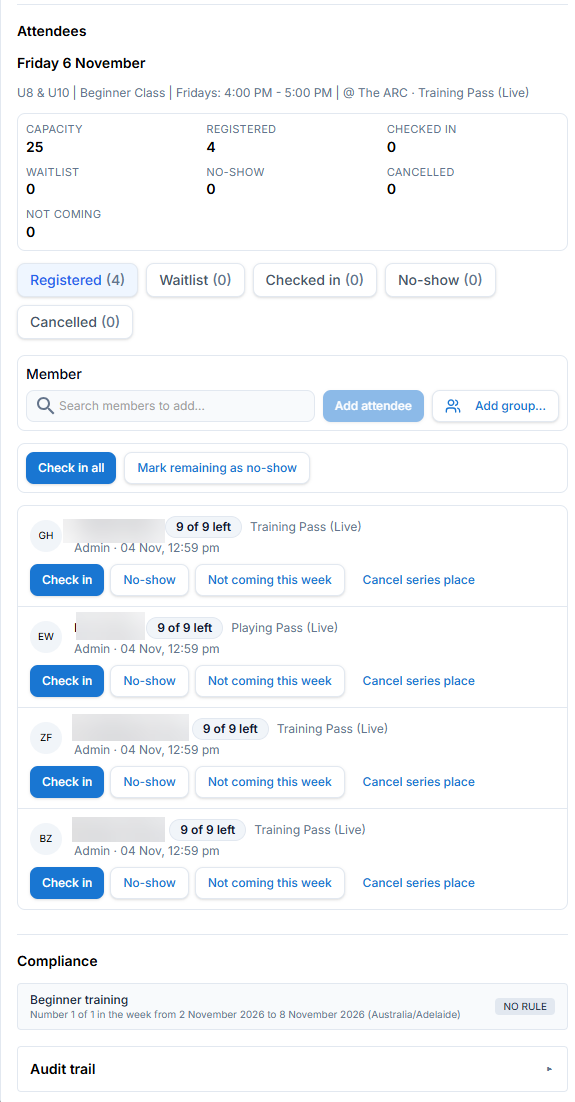
Mobile session management
Smarter Member and Family Management
Family relationships and consent management continue to be important priorities, particularly for organisations working with children.
This week we've tightened our guardian verification, consent and declaration processes.
We've also improved family invitations and how family relationships appear within member management screens.
These capabilities might not sound particularly exciting, but they're critical when building software intended for sporting clubs, schools, academies and youth organisations.
Better Billing and Customer Follow-up
We're continuing to improve the visibility of transactions and the tools available to follow up on incomplete payments, outstanding onboarding requirements and customer actions.
Our aim is to reduce the amount of manual reconciliation and chasing that administrators need to perform.
The less time people spend finding missing information, the more time they can spend serving their community.
AI and Knowledge Retrieval
We've also progressed our AI capabilities, including retrieval-augmented generation (RAG).
Put simply, RAG helps AI find and use relevant information from a knowledge source when responding to questions.
This forms part of our longer-term ambition to make Orbit increasingly accessible through natural-language interactions.
Imagine asking Orbit to help configure a membership programme, explain how a workflow operates or find the right information without navigating through multiple screens.
We're steadily building the foundations for that experience.
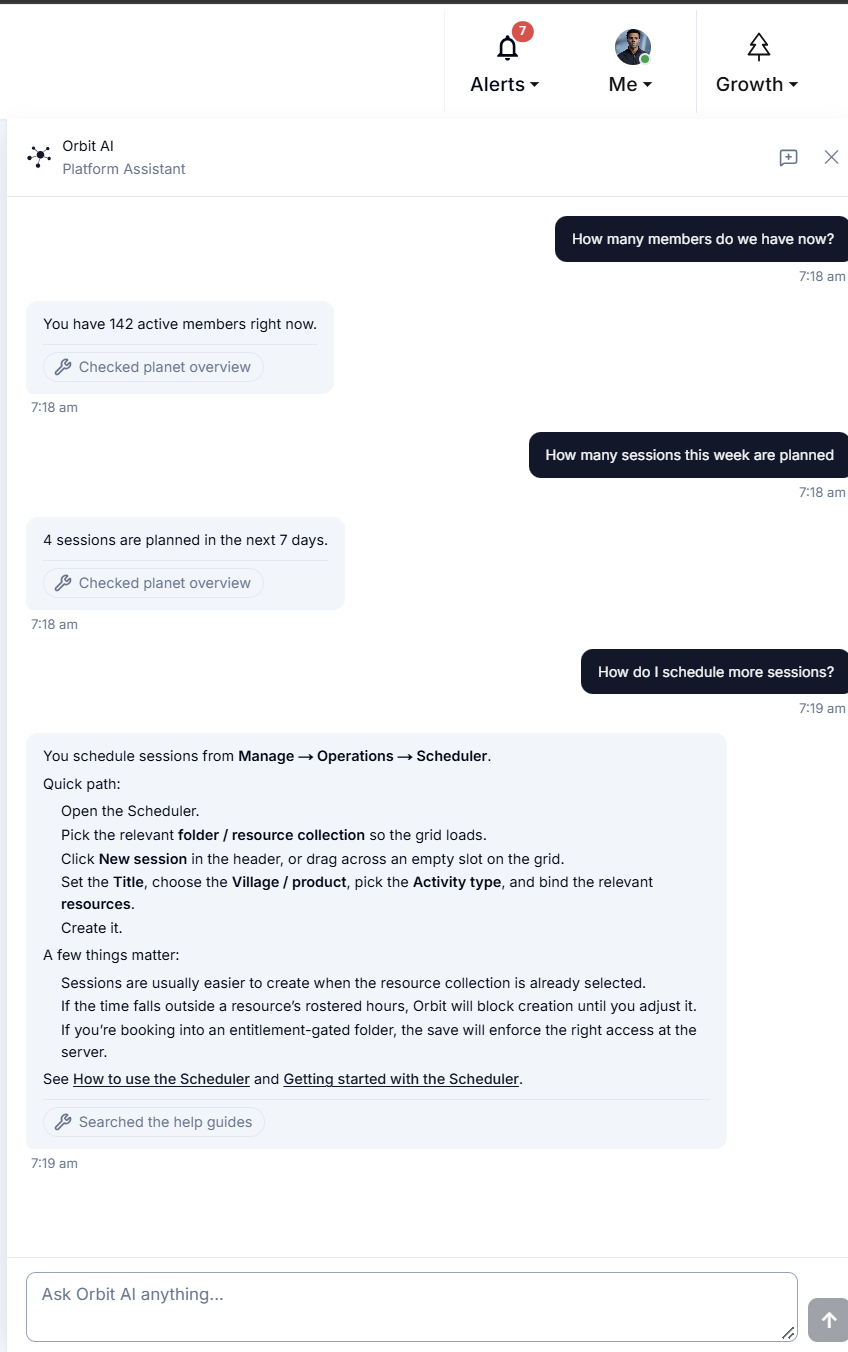
Orbit AI Chat
Community Engagement and Content
We've introduced more flexibility around communicating specifically with prospective members, rather than only existing customers.
We've also continued improving the mobile community feed, making events and Orbit news more accessible.
For us, engagement is a fundamental part of the product, not an afterthought.
🌐 Our Community Builder Vision
There's an important distinction between managing an organisation and building a community.
Most traditional management systems do a reasonable job of maintaining lists, processing transactions and recording activities.
But our vision for Orbit extends beyond administration.
We want organisations to be able to create their own connected communities, build relationships, share knowledge, promote opportunities and encourage participation.
A community might be built around a sporting club, a coaching programme, an event, a shared interest or a professional network.
What excites us is how these communities can potentially connect with one another to create even greater opportunities.
This is central to why we describe Orbit as a value network, rather than simply another software management platform.
We're developing the community-building and engagement capabilities to help bring that vision to life.
⚡ Moving Faster Without Compromising Quality
One of the less visible areas of progress has been improving our software delivery processes.
Orbit is evolving rapidly, and we want to maintain that pace without compromising the quality or reliability of what we're building.
This week we've been refining our Continuous Integration and Continuous Deployment (CI/CD) processes.
A few practical changes include running appropriate validation processes in parallel, reducing unnecessary checks for documentation-only changes, and consolidating user documentation updates into a regular four-day cycle rather than coupling them to every deployment.
We've also strengthened our deployment safeguards and operational monitoring.
The objective isn't simply to release software faster.
It's to create a development environment where improvements can move from idea to customer value quickly, consistently and safely.
That's particularly important when you're building a platform containing multiple interconnected modules.
🔭 What's Coming Next Week?
Our focus next week will increasingly turn towards large-scale community engagement and messaging.
We've already built a range of capabilities for notifications, campaigns and member communications, but we want to make it significantly easier for organisations to communicate with large and diverse groups of people.
For sporting clubs and community organisations, communication can be one of the biggest administrative burdens.
Coordinating programmes, reaching families, promoting activities and following up with the right people all take considerable time.
We want Orbit to help make those activities far more efficient, personalised and manageable.
We'll also continue testing Commerce, improving the booking experience and progressing conversations with the organisations exploring how Orbit might support their needs.
💬 A Final Thought
Two weeks into sharing these diaries, one thing is becoming increasingly clear to me.
Building Orbit isn't just about writing software.
It's about understanding the problems people face, building relationships, earning trust and creating opportunities that weren't previously possible.
Sometimes that means developing a sophisticated point-of-sale system.
Sometimes it means negotiating insurance policies or reviewing legal agreements.
Sometimes it means sitting down with people who have an exciting idea and figuring out how technology can help make it happen.
And sometimes it means putting a cat in front of a camera.
It's all part of the journey.
Chris and I are incredibly grateful to everyone who has taken the time to speak with us, offer feedback, explore ideas or support what we're building.
We're still very early in this adventure, but the momentum is encouraging.
We're not simply building software to help organisations manage what they already do. We're building a platform to help them discover what they could do next.
Thanks for following along. There's plenty more to come.
Andrew Jantke
Co-Founder, Orbit
Until next week — keep exploring! 🚀