
Written by:
As Orbit gets ready to go to market, we'll be publishing a series of product articles like this one so our community can learn more about what Orbit does. They aren't sales pitches. We want to share ideas, talk honestly about the problems community organisations face, and hear how things could be done better. If Orbit ends up being the tool you use to solve those problems in your own community, that's a wonderful by-product.
Running trials or a camp this summer? Tell us how your trials run and we'll set up a Participant Evaluator demo for your squad. To get started, complete this form today:
Three courts, 100 kids, eight coaches and a stack of clipboards
A few weeks ago I sat in the stands at a state trial my son was in. There were more than 100 kids on the floor and about eight coaches watching them. Every coach had a clipboard.
I've been on the other side of that clipboard for a long time. I spent more than 12 years as a Director of Coaching at a representative club, worked with the state high performance program and ran an academy. Last season I coached our club's U14 Division 1 boys. For roughly six spots we had 90 external triallists. Eight or nine of them went into internal trials, and then came selection trials.
That's three rounds of trials, hundreds of player-sessions and thousands of individual judgements. Nearly all of them were written in pen on a printed spreadsheet.
Feedback is what families are really asking for
In every representative and high performance program I've worked in, families ask for one thing more than anything else: feedback. They want to know where their child stands, why they were or weren't selected, and what to work on next.
Good feedback depends on three things:
Getting identification right. With dozens of players and only a few spots, you need every coach's view of every player, not just the players one coach happened to watch.
Accuracy. Judgements should be recorded on the night, against the same criteria, while they're fresh.
Growth. A player who misses out should leave with specific, useful feedback, not a vague "keep working hard".
The clipboard problem
Paper trials fail in the same ways at every club I've worked with:
What happens on the night | What it costs the program |
|---|---|
Each coach watches the players near them | Some players get five sets of notes, others get none |
Notes are scrawled shorthand on a printed list | Nobody else can read or compare them |
Sheets are collated by hand, if at all | Selectors decide from memory and the loudest voice |
Clipboards get left at the stadium | Players' names and judgements sit on a bench for anyone to read |
Parents ask for feedback weeks later | Coaches try to rebuild it from fragments |
That lost clipboard isn't just an inconvenience. It holds children's names and personal judgements about them, left in a public venue. Has that happened at your club?
With this many coaches watching this many players, I'm certain we can serve our members much better than this.
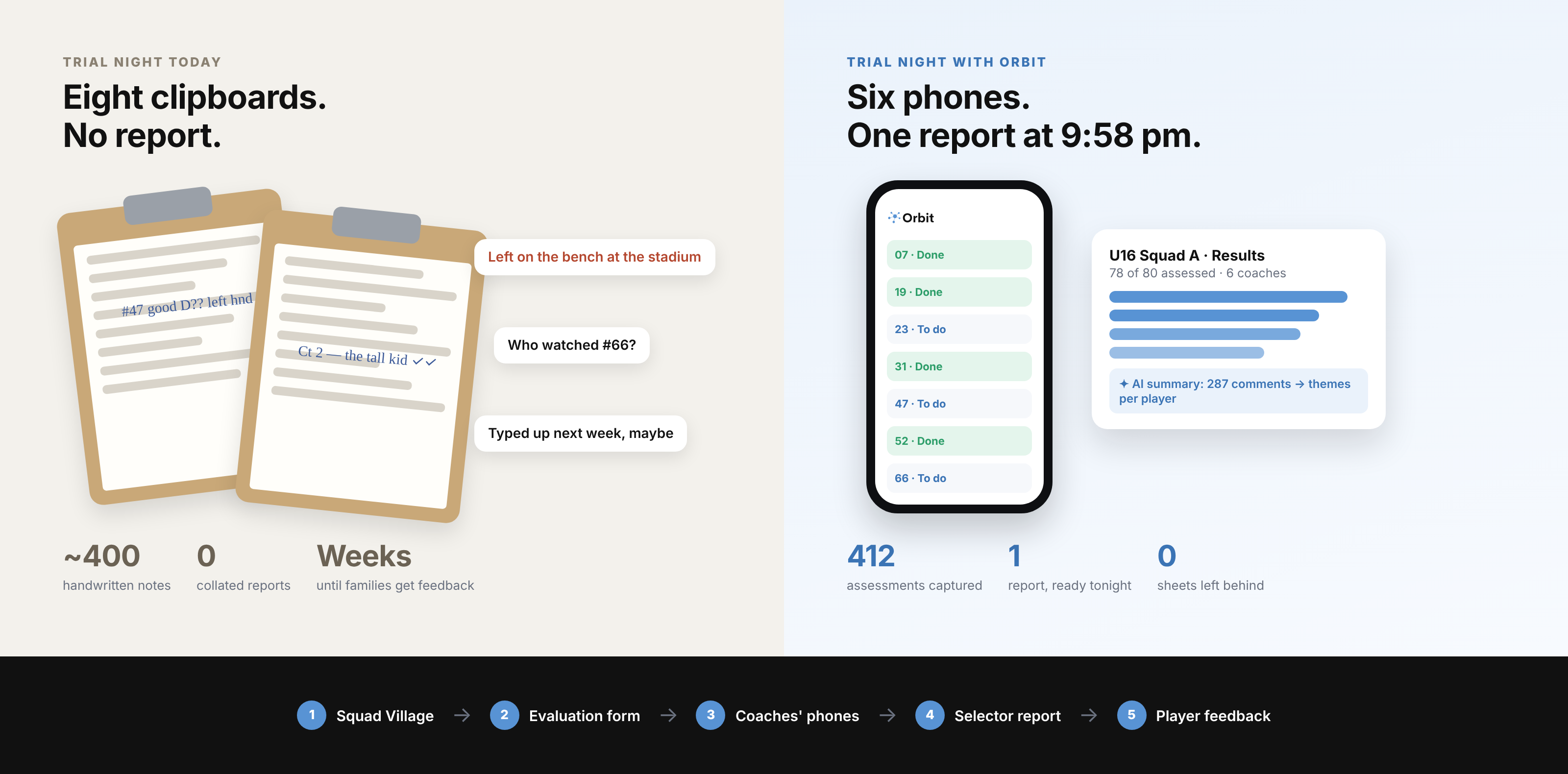
Same trial, two outcomes.
Meet the Participant Evaluator
Orbit is a platform rather than a single app. It has many modules that let a community organisation shape it to how it runs. One small part of the Forms module happens to fix the clipboard problem: the Participant Evaluator.
It works in three steps:
Point it at a group of people. For example, a trial squad, a holiday camp group or a class.
Choose what to capture for each person. You might pick defence, attitude, a ranking by court, a projected division and a comment. You build these fields yourself in the form builder, so they match your club's criteria rather than ours.
Orbit repeats those fields for every person in the group. One form becomes a row per player, which coaches fill in on their phones in a mobile friendly format.
When the group changes, the form changes with it. Add a late triallist to the squad and they appear on every coach's list.
A trial night with Orbit: U16 Squad A
Here's how it looks for a squad of 80 players on three courts, with six coaches and two selectors.
Before the night
The club sets up a Village (Orbit's name for a group) for U16 Squad A. Registrations flow straight into it. Squad coordinators can also place players themselves, but only in the squads their role allows.
The Director of Coaching then builds one evaluation form with a Participant Evaluator pointed at Squad A. These are the fields we'd use:
Field | How coaches record it |
|---|---|
Size and length | Rating, 1–5 |
Ball handling | Rating, 1–5 |
Speed and pace | Rating, 1–5 |
Shooting | Rating, 1–5 |
Attitude | Rating, 1–5 |
Coachability | Rating, 1–5 |
Projected division | Pick from Div 1, Div 2 or Div 3 |
Court moved to | Pick from Court 1, 2 or 3 |
Comments | A short written note |
Every player gets a trial number, which is written on their arm or printed on a bib. That same number shows next to their name in the form.
During the session
Each coach opens the form on their phone. They see all 80 players with a progress count, and they can filter the list to To do to see who they haven't assessed yet.
A coach spots number 47 doing something worth noting. They type 47, open that player's card, tap in three ratings and dictate a one-line comment. It takes about 15 seconds, and then they're watching the floor again.
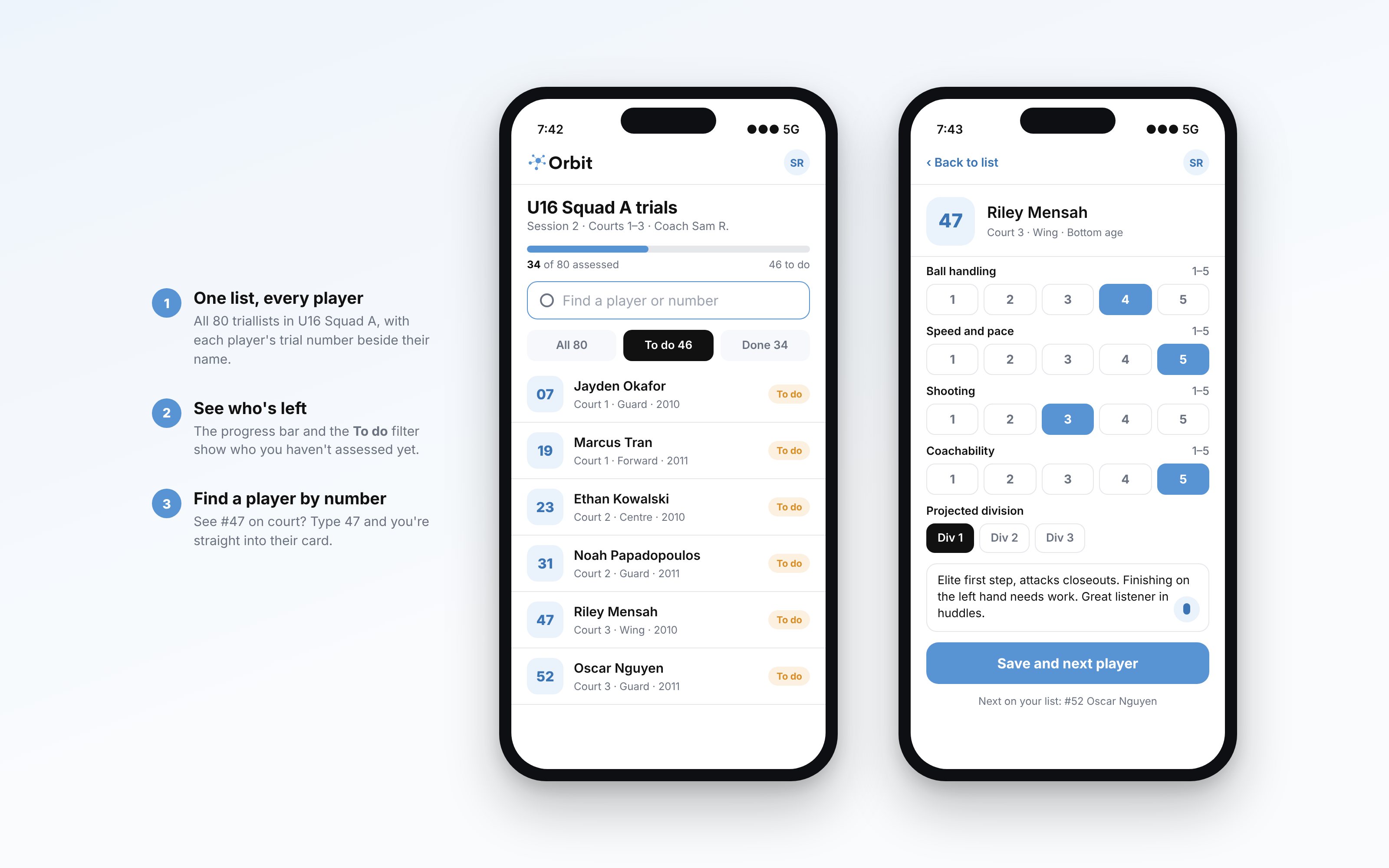
Left: the coach's list, filtered to players still to assess. Right: #47's card.
Ranking by court
Selectors can also rank players. A ranking field works like a position depth chart: each player on Court 1 tonight gets a place from 1 to N, and Orbit won't accept two players in the same place. The same tool handles ranking by position, by bottom or top age, or by any group you define.
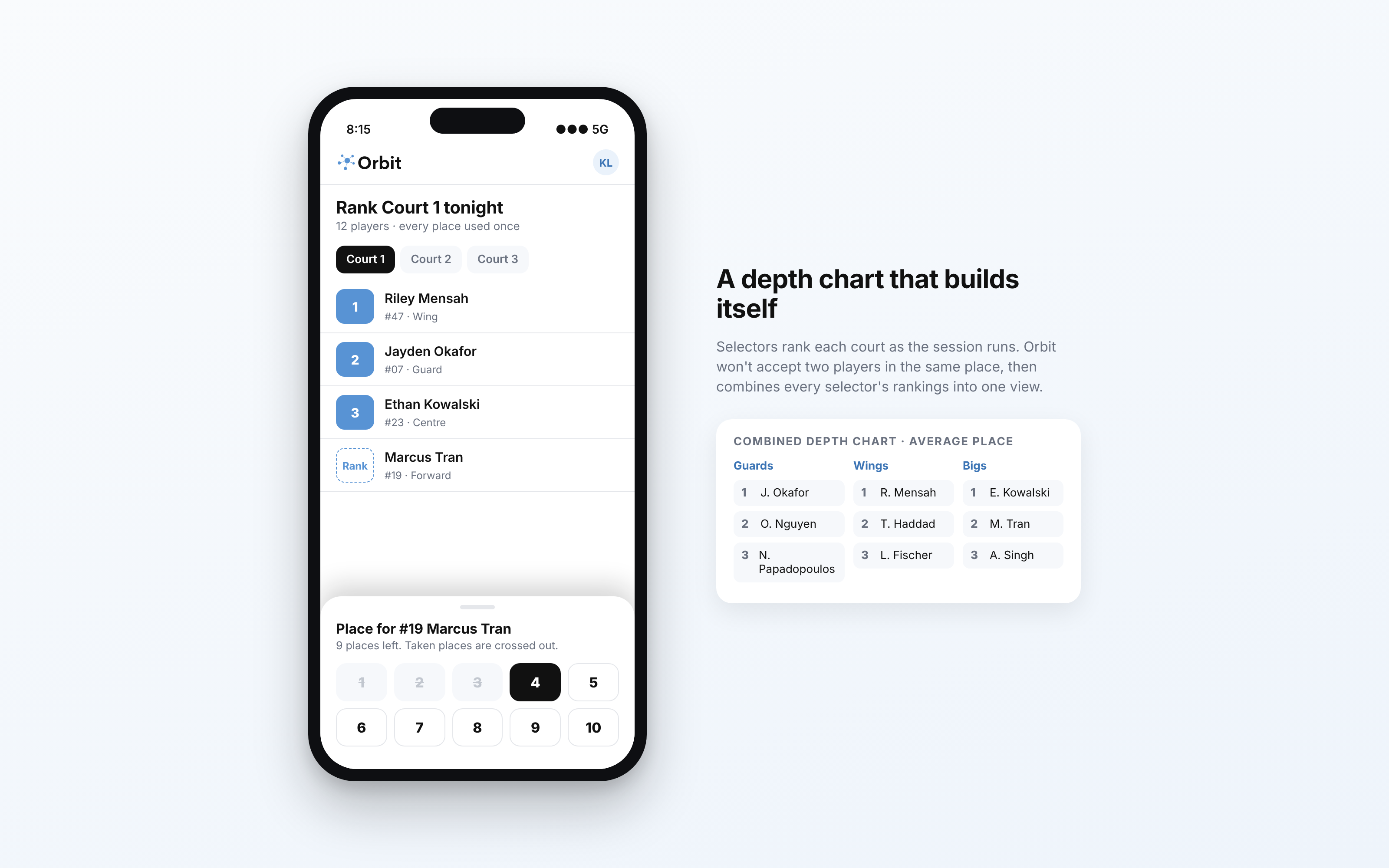
Ranking a court on the phone, and the combined depth chart selectors see afterwards.
After the final whistle: a report, not a pile of paper
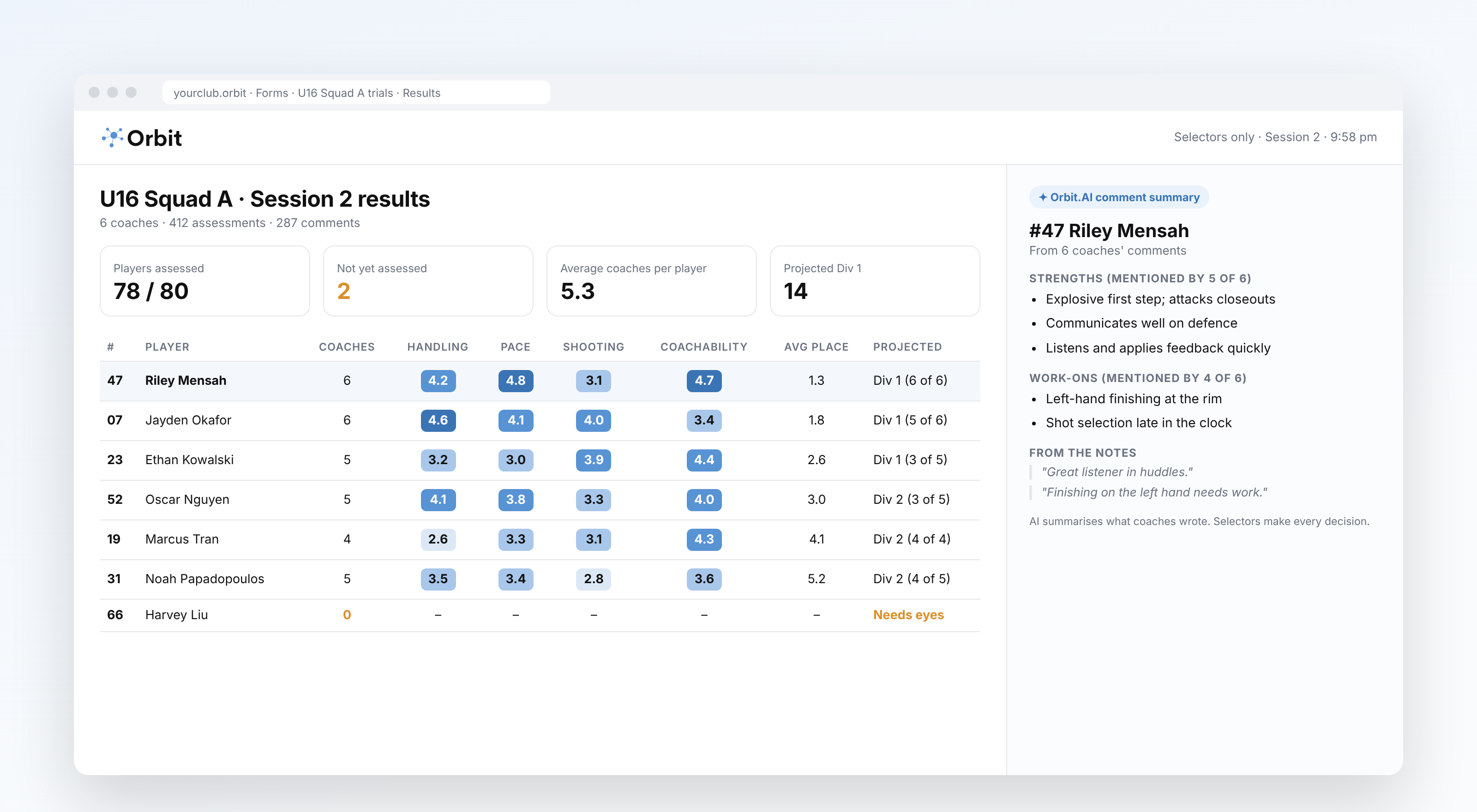
By the time the courts are packed up, the selectors already have a report:
Every player's scores from every coach, with totals, averages and the number of coaches who assessed them. Players nobody has assessed stand out straight away.
Rankings combined across evaluators, showing each player's average place on each court.
An AI summary of the written comments. Orbit's AI reads every coach's notes on a player and pulls out the themes. For example: "Three of four coaches noted strong defensive communication; two flagged weak-hand finishing." Selectors still make the call. The AI just saves them reading 400 comments at 10 pm.
Not just for trials
The Participant Evaluator works anywhere you assess a group of people against the same criteria:
Where | Group | What's recorded for each person |
|---|---|---|
Holiday camps | Each day's camp group | Skills progress, effort and a note for parents |
Academy terms | Each skills class | Skill benchmarks at week 1 and week 8 |
Game day | The team roster | Minutes played, a coach's note, and a 3-2-1 best-and-fairest vote |
Coach development | Coaching applicants | Observation ratings from mentors |
Schools | A class or PE group | Rubric scores against curriculum outcomes |
Competitions | Entrants | Judges' scores, combined automatically |
Wherever you assess people group by group, one form can do the work of a stack of clipboards.
Better tools, better programs
The expertise in a trial lives in the coaches, not the software. What Orbit does is make sure none of that expertise gets lost between the court and the selection meeting. Every judgement is captured, collated and turned into feedback that helps a young player improve.
Put tools like this in the hands of good coaches and the result is fairer selections, players who keep developing, and families who stay with your club. That's a real competitive advantage for any community organisation.