
Is SaaS dead?
Not dead. Just levelling up.
Every few years the tech industry holds a funeral for something that isn't actually dead. Desktop software. Email. The website. This year the casket is labelled SaaS.
The eulogies started in December 2024, when Microsoft CEO Satya Nadella told the BG2 podcast that business applications are essentially databases with business logic on top, and that this logic would move to AI agents, so the idea of separate "apps" could collapse in the agent era. Then, in February 2026, roughly US$285 billion was wiped off software stocks in about 48 hours. Wall Street called it the SaaSpocalypse.
So, is SaaS dead?
At Orbit, our answer is no. SaaS isn't dead. It's going to look very different. And the clubs, schools and academies we build for are about to come out ahead.
What the doomsayers get right
Credit where it's due. Some of SaaS really is under pressure:
• Per-seat pricing is wobbling. If an agent does the work of five logins, why pay for five seats?
• Thin "wrapper" apps are exposed. If your product is a form on top of a spreadsheet, a capable AI can now build something close in an afternoon.
• Clicking through menus is going out of fashion. Agents can skip the click path completely.
Even the bulls agree on this much. One analysis put it neatly: if "SaaS is dead" means the screen layer, that's partly right. If it means the system of record, it's off target. And workflows are case by case.
Our view: the easy SaaS moat is gone. The real one is getting deeper.
Why SaaS isn't dead
1. SaaS is a community of ideas, not just code
People forget this. A good SaaS product is a shared brain. Every customer who asks for a feature, reports a bug or finds a clever workaround makes it better for everyone else. Your organisation gets the season rollover that 50 others helped shape. You get the safeguarding check that someone else learnt the hard way to include.
SaaS also gives your thinking a structure. A well-designed platform turns "we should probably follow up unpaid registrations" into a proven sequence with a clear owner, a deadline and a dashboard. A blank chat window can't do that for you.
2. Building it properly is still hard and expensive
Yes, AI can write code at astonishing speed. We use it every day to build Orbit. But "an app that works on my laptop" and "a platform you can trust with children's data, family payments and a committee's sanity" are separated by a huge gap. That gap is filled with:
• multi-tenant security and data isolation
• audit trails, consent and guardian permissions
• payments, refunds and reconciliation
• durable workflows that don't lose their place when a server restarts
• scalability, monitoring, backups and support
AI makes building faster. It doesn't make those things free. The expertise, the platform and the best practices still have to come from somewhere, and spreading that cost across a community of customers is exactly what SaaS does best.
3. Chat has a cognitive load problem
Chat is magic for a one-off question. For repetitive work it's a treadmill.
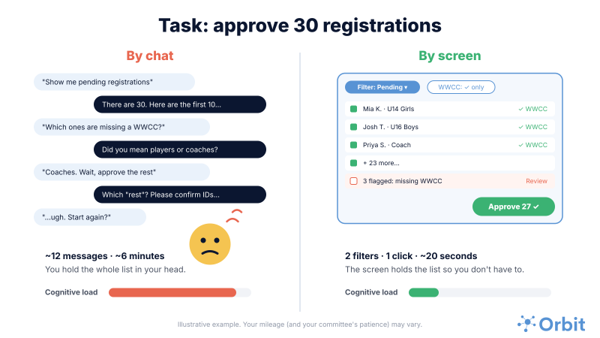
Try approving 30 registrations by chat. You ask, it lists ten, you clarify, it asks which "rest" you meant, and so on. You have to hold the whole picture in your head. On a screen, two filters and one click do the job, because the interface holds the context for you.
For quick, repetitive, high-volume tasks, a good UI beats a conversation. That's not nostalgia. It's ergonomics.
4. Collaboration is richer with a UI
Think about the difference between a social feed and a group chat. The feed lets you scan, react, filter, catch up and see what matters at a glance. The chat is a scrolling wall you hope you didn't miss something in.
Communities run on collaboration: coaches, managers, parents, volunteers and players all looking at the same fixture, the same roster, the same announcement. Shared screens, feeds and dashboards make that work. Twelve people each prompting their own AI assistant does not.
5. Best practice lives in the interface
Some of the most valuable things a platform gives you are things you didn't know to ask for:
• the retention metric that warns you a junior team is about to fold
• the compliance check that must happen before someone coaches
• the workflow step that can't be skipped, however busy Tuesday night gets
A headless, chat-only system only answers the questions you think to ask. A well-designed product puts proven practice in front of you and enforces the sequences that matter. That's much harder to deliver through a prompt box.
6. The system of record is the moat
Agents are only as good as the data they can trust. Who's registered, who's paid, who holds a current Working with Children Check, which parent can see which child's details. That system of record is the ground truth that every agent, report and workflow stands on.
Owning it well, securely, accurately and with history, is a deep and durable moat. Agents don't remove the need for it. They make it more important.
7. People still need people
Here's the part we feel most strongly about.
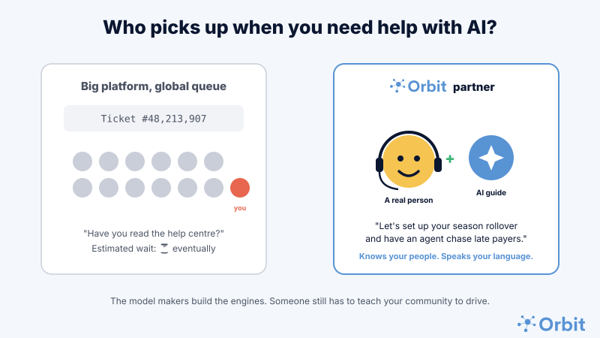
The big AI labs are building extraordinary engines, and we build on them happily. But they serve hundreds of millions of people, so their support is, understandably, mostly help centres and AI-first queues. Try getting a person on the phone to help set up AI agents for your under-12s netball program. Good luck with that.
What's next: the headless hybrid
So if SaaS isn't dying, what is it becoming? We think the answer is the headless hybrid.
The headless hybrid: one engine, two front doors
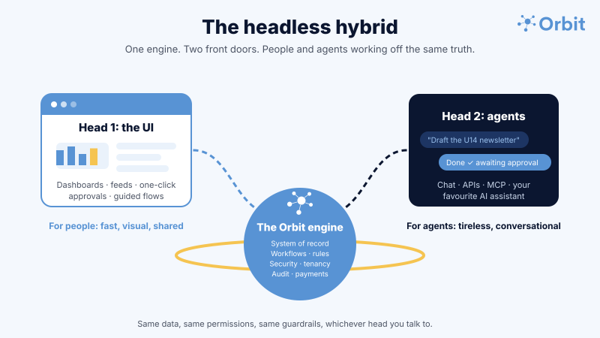
One engine, two front doors:
• Head 1, the UI. Dashboards, feeds, one-click approvals and guided flows for the people who run and enjoy your community.
• Head 2, the agents. Chat, APIs and AI assistants that draft, chase, schedule and summarise in the background.
Both heads talk to the same engine: the same data, permissions, workflows and audit trail. An agent drafts the newsletter and a human approves it on screen. A parent asks a question in chat and the answer comes from the same record the registrar sees.
That's how Orbit is built. Our AI drafts content and looks things up, and it asks for confirmation before it changes anything. Agents do the legwork. People stay in charge.
The giants are big, and the market is bigger
Let's talk scale. These are some of the specialists a typical community organisation stitches together today:
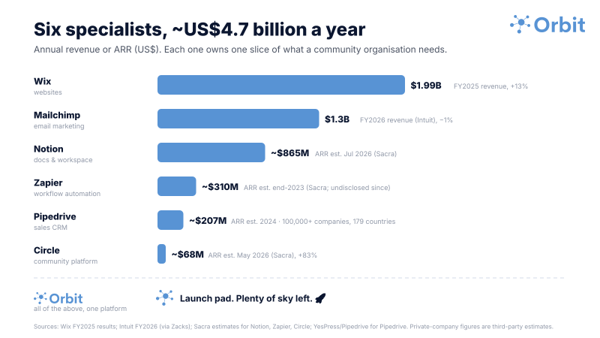
Six specialist SaaS vendors and their annual revenue
Together that's roughly US$4.7 billion a year, and that's just six logos. Look closer and you'll see two stories at once:
• Some incumbents are struggling to adapt. Mailchimp shrank slightly while Intuit grew 14%, and Intuit now runs it as its own separate segment.
• Others are thriving by embracing AI. Wix's vibe-coding platform Base44 reached US$100M ARR about a year after it was founded. Notion and Circle are growing fast with built-in agents.
And the pie keeps growing. Gartner expects worldwide software spending to reach about US$1.44 trillion in 2026, up 15%, making software the fastest-growing category in IT. In Australia alone, SaaS spending is forecast at around A$16 billion.
That's the point. Even with fragmentation and fierce competition, the market is so big that focused, smaller vendors can absolutely build great businesses. You don't need to beat Wix at websites everywhere. You need to be brilliant for the people you serve.
Where Orbit fits: one Planet, not six logins
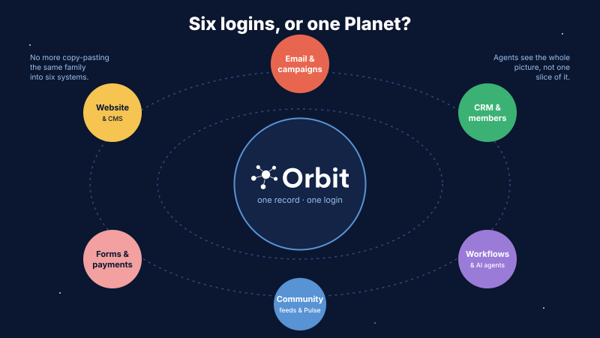
Orbit replaces six separate systems with one platform
Orbit is building a single home for community organisations, with 23 systems across five areas:
• Attract: sites, CMS, campaigns, forms
• Relate: CRM, members, families, profiles
• Earn: products, payments, POS, ticketing
• Run: scheduling, resources, Pulse, notifications, insights
• Automate: workflows, AI, connectors, facets
Each of those areas has a specialist giant. We're getting close to going head to head with each of them in our market, but with one big difference: it's all one platform. One login. One record of every member and family. One set of permissions. And one place for your agents to work, so they see the whole picture instead of one slice of it.
Apps solve a task. Platforms compound.
More information on Orbit's 23 core modules here:
The Orbit platform — every system your community runs on
So… is SaaS dead?
Honestly? Nobody knows exactly what the future holds. Anyone who tells you they do is probably selling the funeral.
But here's what we're confident about:
• SaaS is changing: less clicking, more agents, more outcome-based value.
• The UI isn't going anywhere for collaboration, repetitive work and proven best practice.
• The system of record is becoming more valuable, not less.
• Organisations need a partner, not just a model, to make the most of AI.
At Orbit, we feel confident that SaaS is here to stay. It's just levelling up, and we're building the version where your community grows, not your admin.
Want to see what a headless hybrid looks like for your organisation? Book a Take Off session and we'll show you.